
| REPORT ATTRIBUTE | DETAILS |
|---|---|
| Historical Period | 2020-2023 |
| Base Year | 2024 |
| Forecast Period | 2025-2032 |
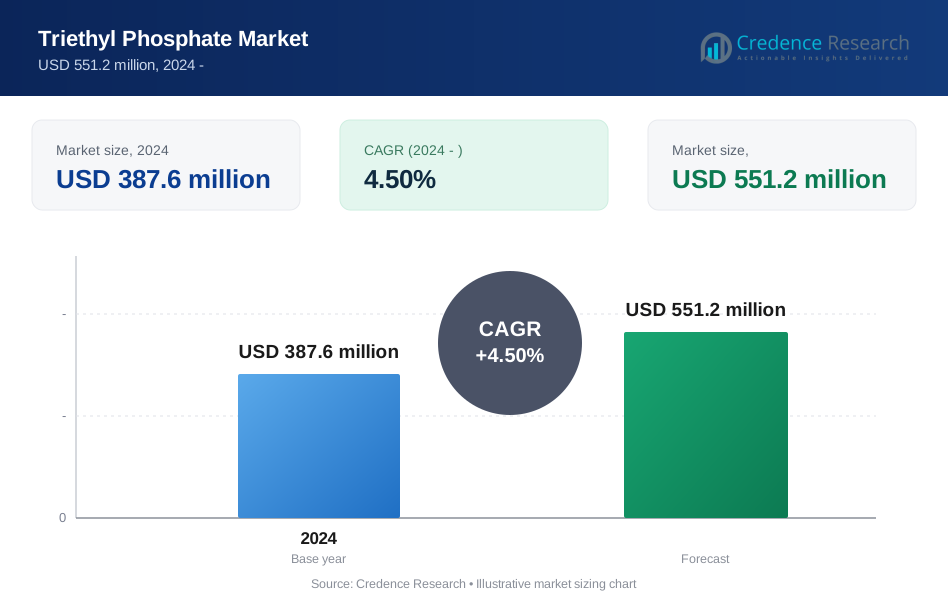
| Triethyl Phosphate Market Size 2024 | USD 387.6 million |
| Triethyl Phosphate Market, CAGR | 4.50% |
| Triethyl Phosphate Market Size 2032 | USD 551.2 million |
Market Overview
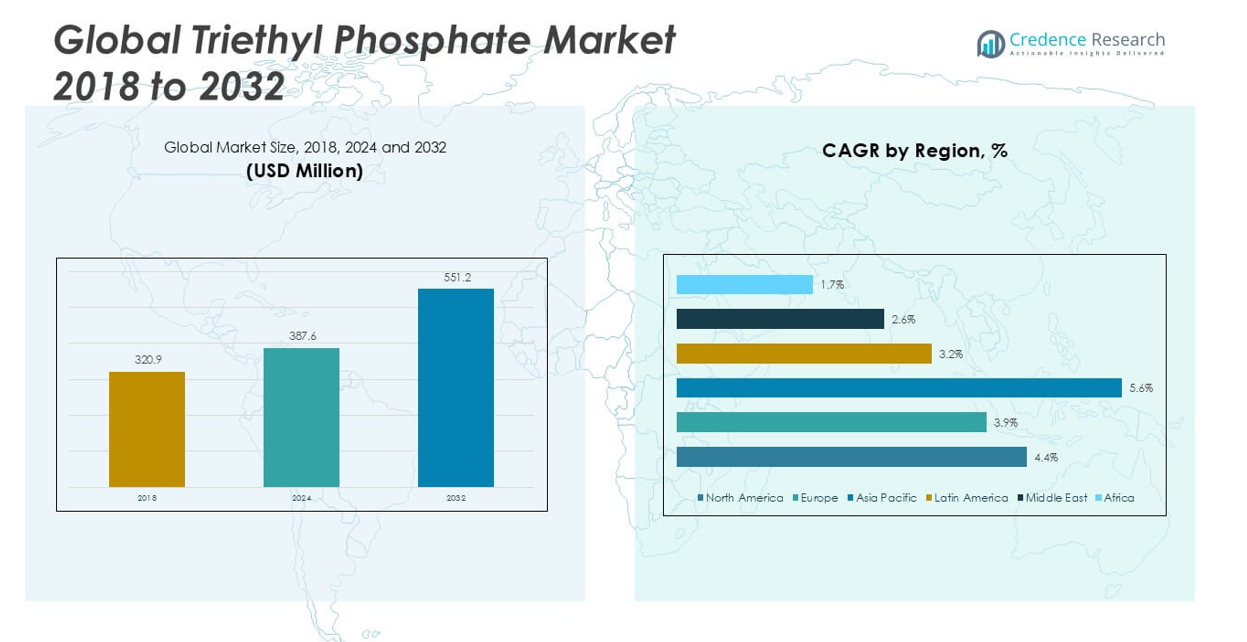
The Triethyl Phosphate market size was valued at USD 320.9 million in 2018, increased to USD 387.6 million in 2024, and is anticipated to reach USD 551.2 million by 2032, at a CAGR of 4.50% during the forecast period.
The Triethyl Phosphate market is characterized by the presence of major global players such as Eastman Chemical Company, Lanxess AG, Merck KGaA (Sigma-Aldrich), Thermo Fisher Scientific Inc., Dow Chemical Company, BASF SE, Solvay S.A., AkzoNobel N.V., Clariant AG, and Evonik Industries AG. These companies drive market innovation through advanced product portfolios, extensive distribution networks, and strategic investments in R&D. Asia Pacific leads the global market with a commanding 39% share in 2024, fueled by rapid industrialization and strong demand across chemical, construction, and electronics sectors. North America and Europe follow, accounting for approximately 24% and 21.5% of the market, respectively, underscoring the region’s industrial maturity and adherence to stringent safety standards.
Market Insights
- The Triethyl Phosphate market reached USD 387.6 million in 2024 and is projected to grow at a CAGR of 4.50% to USD 551.2 million by 2032.
- Rising demand for flame retardants in construction, automotive, and electronics industries acts as a primary growth driver, supported by regulatory emphasis on fire safety.
- The market is witnessing a clear trend toward halogen-free and environmentally friendly flame retardant solutions, with increasing innovation from major global chemical manufacturers.
- Asia Pacific leads the market with a 39% share, followed by North America at 24% and Europe at 21.5%, while the flame retardant application segment accounts for over 40% of total demand.
- High production costs, raw material price volatility, and compliance with varying regulatory standards across regions restrain overall market expansion, particularly in developing economies.
Market Segmentation Analysis:
By Application:
In the Triethyl Phosphate market, the flame retardant segment holds the dominant share, accounting for over 40% of total application demand. This leadership is driven by the rising adoption of triethyl phosphate in fire safety solutions across the construction, electronics, and automotive industries. Regulatory emphasis on fire safety standards and the shift toward halogen-free flame retardants continue to accelerate demand in this segment. Chemical catalysts and organic solvents represent secondary segments, benefitting from increased industrial and chemical synthesis activities in emerging economies.
- For instance, Eastman Chemical Company’s Phosphates Technology Division supplied triethyl phosphate for flame retardant systems used in 8,400 metric tons of insulation foam products in 2022.
By Product:
The industrial grade segment leads the Triethyl Phosphate market, capturing approximately 60% of the product volume share. This dominance is attributed to the widespread use of industrial grade triethyl phosphate in manufacturing flame retardants, plasticizers, and specialty chemicals. Superior grade triethyl phosphate, although used in niche applications requiring higher purity, holds a smaller market share. The robust expansion of end-use industries and the cost-effectiveness of industrial grade variants act as key drivers supporting its continued leadership in the product segment.
- For instance, BASF SE reported an annual production output of 11,200 metric tons of industrial grade triethyl phosphate at its Ludwigshafen facility in 2023.
Market Overview
Expanding Applications in Flame Retardants
The increasing demand for flame retardant materials in construction, electronics, and automotive industries serves as a major growth driver for the Triethyl Phosphate market. Stringent fire safety regulations and a growing focus on halogen-free additives have accelerated the adoption of triethyl phosphate as an effective flame retardant. Manufacturers increasingly prefer this compound due to its superior fire resistance and low toxicity, which further drives market expansion across multiple industrial sectors seeking safer and more sustainable solutions.
- For instance, Lanxess AG delivered triethyl phosphate-based flame retardants for over 35 million automotive cable harnesses in 2022.
Rising Demand in Agrochemical Production
The market is experiencing notable growth from the expanding use of triethyl phosphate as an intermediate in pesticide and agrochemical synthesis. Agriculture-dependent economies are investing in crop protection and yield optimization, creating a steady demand for advanced pesticides and fertilizers. The compound’s versatility and effectiveness in chemical synthesis processes make it a preferred choice among agrochemical manufacturers, reinforcing its position as a critical raw material in the agricultural sector.
- For instance, Merck KGaA (Sigma-Aldrich) reported distributing triethyl phosphate to more than 120 pesticide formulation plants globally in 2023.
Growth in Industrial Chemical Synthesis
Ongoing advancements in chemical manufacturing and processing are driving the adoption of triethyl phosphate as a catalyst and organic solvent. Its unique properties—such as high solvency and compatibility with various chemicals—support a wide range of industrial applications. Growing investments in specialty chemicals and pharmaceuticals, particularly in emerging economies, are further enhancing the market potential for triethyl phosphate in diverse chemical synthesis operations.
Key Trend & Opportunity
Shift Toward Eco-Friendly Flame Retardants
A prominent trend in the Triethyl Phosphate market is the shift toward environmentally friendly flame retardants. Regulatory agencies and end users are demanding safer, non-halogenated options, driving innovation in triethyl phosphate-based formulations. This trend presents growth opportunities for manufacturers focusing on sustainable product development, positioning triethyl phosphate as a preferred solution in global fire safety and materials engineering sectors.
- For instance, Solvay S.A. launched an eco-friendly flame retardant line based on triethyl phosphate that achieved certification for use in 430 distinct electronic device models in 2023.
Expanding Applications in High-Value Industries
Triethyl phosphate is witnessing increasing utilization in high-value industries such as electronics, aerospace, and specialty coatings. These sectors require advanced performance materials for specific functional requirements, and triethyl phosphate offers significant advantages due to its chemical stability and versatility. The ongoing expansion of these industries in Asia-Pacific and other emerging markets presents ample opportunities for suppliers and formulators to diversify their offerings and tap into new revenue streams.
- For instance, AkzoNobel N.V. reported the application of triethyl phosphate-based additives in protective coatings for 210 commercial aircraft delivered in 2023.
Key Challenge
Regulatory Compliance and Safety Concerns
The Triethyl Phosphate market faces ongoing challenges related to regulatory compliance and occupational safety. Strict guidelines on the handling, transportation, and disposal of organophosphates increase operational complexities and costs for manufacturers. Ensuring compliance with diverse regional regulations while maintaining product safety standards remains a critical concern for industry stakeholders, particularly in export-driven markets.
Volatility in Raw Material Prices
Fluctuating prices of raw materials used in triethyl phosphate production present a significant challenge to market stability. Variations in the availability and cost of key inputs, such as ethanol and phosphorus derivatives, can disrupt supply chains and erode profit margins. Manufacturers must adopt efficient procurement strategies and explore alternative sourcing options to mitigate the impact of raw material price volatility on overall business performance.
Regional Analysis
North America
North America held a market share of approximately 24% in 2024, with the Triethyl Phosphate market valued at USD 93.0 million, rising from USD 83.4 million in 2018. The market is projected to reach USD 118.5 million by 2032, reflecting a CAGR of 4.4%. Strong demand stems from the region’s advanced chemical, construction, and electronics industries, all of which prioritize fire safety and regulatory compliance. Ongoing innovation in flame retardant applications and a robust industrial sector position North America as a key contributor to global market growth.
Europe
Europe accounted for around 21.5% of the global Triethyl Phosphate market in 2024, with a market value of USD 83.3 million, up from USD 75.4 million in 2018. By 2032, the region is forecasted to reach USD 109.1 million, posting a CAGR of 3.9%. The European market benefits from stringent safety regulations, increasing investment in eco-friendly materials, and a well-established manufacturing base. The emphasis on sustainable flame retardant solutions and growing demand in specialty chemicals continue to drive market expansion across major European economies.
Asia Pacific
Asia Pacific emerged as the largest regional market, commanding a 39% share in 2024 with a value of USD 151.9 million, up significantly from USD 109.7 million in 2018. Expected to reach USD 242.5 million by 2032, the region leads with a robust CAGR of 5.6%. Rapid industrialization, especially in China and India, along with rising construction and electronics manufacturing, drives demand for triethyl phosphate. Government initiatives supporting chemical sector growth and increasing safety standards underpin the region’s leading market position.
Latin America
Latin America represented about 5% of the Triethyl Phosphate market in 2024, reaching USD 19.4 million from USD 18.0 million in 2018. The market is projected to expand to USD 29.2 million by 2032 at a CAGR of 3.2%. The region’s market development is supported by growing investment in agriculture and agrochemicals, as well as an expanding construction sector. Increased adoption of advanced materials in industrial and safety applications is further supporting demand, though overall market growth remains moderate compared to Asia Pacific and North America.
Middle East
The Middle East accounted for a 6.8% market share in 2024, with the Triethyl Phosphate market valued at USD 26.4 million, increasing from USD 22.5 million in 2018. Forecasts suggest the region will reach USD 35.8 million by 2032, reflecting a CAGR of 2.6%. The market is driven by developments in the construction and chemical industries, particularly in Gulf Cooperation Council (GCC) countries. Despite a relatively slower growth rate, ongoing infrastructure projects and industrial diversification efforts are expected to provide moderate opportunities for market expansion.
Africa
Africa held a 3.5% share of the global Triethyl Phosphate market in 2024, with a value of USD 13.6 million, up from USD 11.9 million in 2018. By 2032, the market is projected to reach USD 16.0 million, recording the lowest CAGR among all regions at 1.7%. Market growth is primarily limited by lower industrialization rates and reduced demand for advanced flame retardant and chemical applications. However, gradual economic development and investments in key sectors may foster incremental growth opportunities for the Triethyl Phosphate market in Africa.
Market Segmentations:
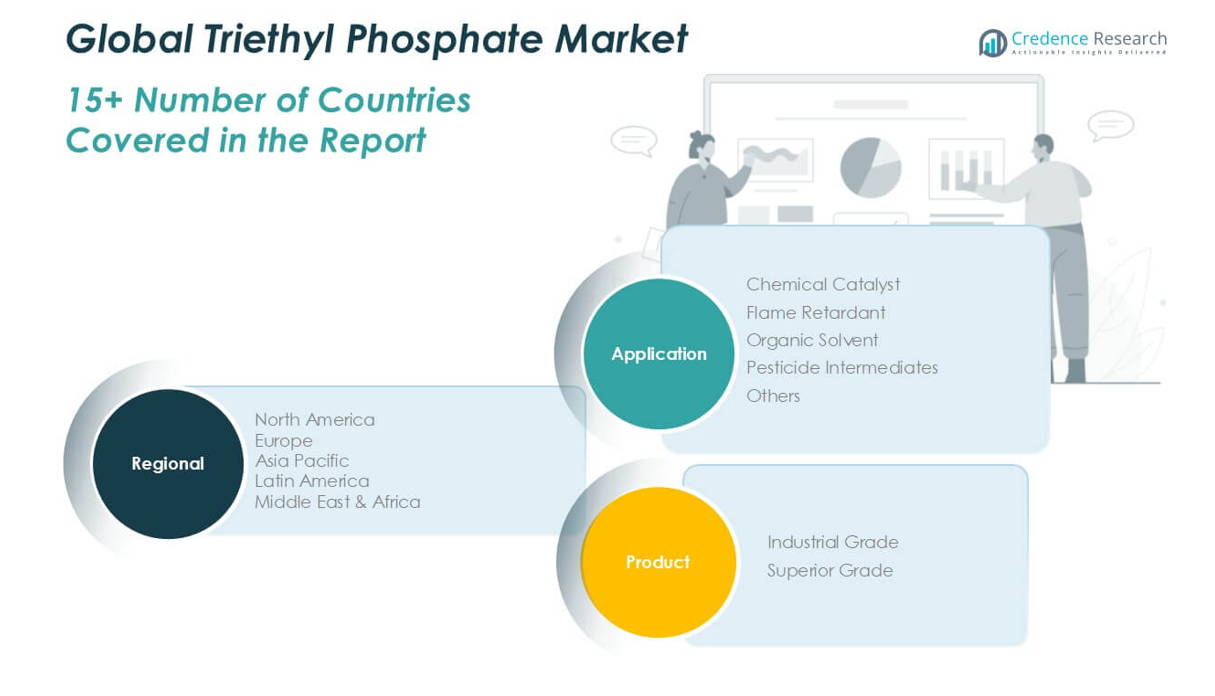
By Application
- Chemical Catalyst
- Flame Retardant
- Organic Solvent
- Pesticide Intermediates
- Others
By Product
- Industrial Grade
- Superior Grade
By Geography:
- North America
- U.S.
- Canada
- Mexico
- Europe
- Germany
- France
- U.K.
- Italy
- Spain
- Rest of Europe
- Asia Pacific
- China
- Japan
- India
- South Korea
- South-east Asia
- Rest of Asia Pacific
- Latin America
- Brazil
- Argentina
- Rest of Latin America
- Middle East & Africa
- GCC Countries
- South Africa
- Rest of the Middle East and Africa
Competitive Landscape
The competitive landscape of the Triethyl Phosphate market is defined by the presence of several leading multinational chemical companies, each leveraging robust R&D capabilities and extensive global distribution channels. Key players such as Eastman Chemical Company, Lanxess AG, Merck KGaA (Sigma-Aldrich), Thermo Fisher Scientific Inc., Dow Chemical Company, BASF SE, Solvay S.A., AkzoNobel N.V., Clariant AG, and Evonik Industries AG maintain a strong market presence through diversified product offerings and ongoing innovation in flame retardant and chemical catalyst applications. Strategic alliances, acquisitions, and capacity expansions remain common approaches to strengthening their market positions and addressing the rising demand in high-growth regions, particularly Asia Pacific. These companies continually invest in sustainable and high-performance product development to meet evolving regulatory standards and customer requirements. The market’s competitive dynamics are further shaped by a focus on operational efficiency and customer-centric service, driving long-term growth and resilience.
Key Player Analysis
- Eastman Chemical Company
- Lanxess AG
- Merck KGaA (Sigma-Aldrich)
- Thermo Fisher Scientific Inc.
- Dow Chemical Company
- BASF SE
- Solvay S.A.
- AkzoNobel N.V.
- Clariant AG
- Evonik Industries AG
- Huntsman Corporation
- Mitsubishi Gas Chemical Company
- Ningguo Long Day Chemical
- Jilin Yonglin Chemical
Market Concentration & Characteristics
The Triethyl Phosphate Market exhibits a moderate to high level of market concentration, with a handful of multinational chemical corporations accounting for a significant share of global production and sales. It is characterized by well-established supply chains, advanced manufacturing technologies, and strong R&D capabilities among leading players such as Eastman Chemical Company, Lanxess AG, Merck KGaA (Sigma-Aldrich), and BASF SE. The market shows strong integration across the value chain, from raw material sourcing to end-user distribution, which supports operational efficiency and product quality. It benefits from diversified applications, including flame retardants, chemical catalysts, and pesticide intermediates, with the flame retardant segment leading in terms of volume share. Regulatory compliance, especially with regard to environmental and safety standards, shapes the competitive environment and drives continuous innovation. Regional demand dynamics further influence market characteristics, with Asia Pacific standing out due to rapid industrial growth and high consumption in construction and electronics sectors.
Report Coverage
The research report offers an in-depth analysis based on Application, Product, and Geography. It details leading market players, providing an overview of their business, product offerings, investments, revenue streams, and key applications. Additionally, the report includes insights into the competitive environment, SWOT analysis, current market trends, as well as the primary drivers and constraints. Furthermore, it discusses various factors that have driven market expansion in recent years. The report also explores market dynamics, regulatory scenarios, and technological advancements that are shaping the industry. It assesses the impact of external factors and global economic changes on market growth. Lastly, it provides strategic recommendations for new entrants and established companies to navigate the complexities of the market.
Future Outlook
- The market will continue to expand with increasing demand in flame retardant applications across sectors.
- Growth in chemical intermediates for agrochemicals will sustain long-term consumption.
- Producers will invest in high-purity grades to meet specialty application requirements.
- Regulatory incentives for environmentally safe materials will support market adoption.
- Manufacturers will establish production facilities in Asia Pacific to capture regional demand.
- Partnerships between chemical firms and end-user industries will enhance market penetration.
- Optimization of supply chains will improve cost efficiency and responsiveness.
- Innovation in non-halogenated formulations will drive product differentiation.
- Development of bio-based feedstocks may reshape raw material sourcing.
- Digital technologies and process automation will increase manufacturing precision and reduce downtime.
Request a Free Sample
Fill in your details and we'll send you a free sample report.
- Sample data tables & charts
- Research methodology
Need a Custom Version of This Report?
Tailor the scope, geography, or segments to your exact requirements.
- Custom geography or segment scope
- Direct access to our analyst team
Frequently Asked Questions
What is the current size of the Triethyl Phosphate Market?
What factors are driving the growth of the Triethyl Phosphate Market?
What are some challenges faced by the Triethyl Phosphate Market?
Who are the major players in the Triethyl Phosphate Market?
Table of Content
Chapter 1. Report Introduction
- 1.1 Report Description & Purpose
- 1.1.1 Report Title & Market Definition
- 1.1.2 Unique Selling Propositions (USP) & Key Differentiators
- 1.1.3 Value Proposition for Stakeholders
- 1.2 Research Objectives
- 1.2.1 Market Sizing Objectives (Volume & Revenue)
- 1.2.2 Segmentation Objectives
- 1.2.3 Competitive Intelligence Objectives
- 1.2.4 Forecast & Scenario Objectives
- 1.3 Report Scope
- 1.3.1 Triethyl Phosphate Scope – Types & Subtypes Covered
- 1.3.2 Geographic Scope – Regions & Countries Covered
- 1.3.3 Historical Period, Base Year & Forecast Period (2024; forecast to the forecast period)
- 1.3.4 Inclusions & Exclusions
- 1.4 HS Code & Classification Framework
- 1.5 Currency, Units & Pricing Basis
- 1.6 Target Stakeholders
- 1.7 Limitations & Assumptions
Chapter 2. Executive Summary
- 2.1 Global Triethyl Phosphate Market Snapshot
- 2.1.1 Market Size – Historical (2024) & Forecast (the forecast period) (2024: USD 387.6 million → forecast year: USD 551.2 million)
- 2.1.2 Volume & Revenue – Global Totals
- 2.1.3 Key Market Highlights – Top Five Facts
- 2.2 Triethyl Phosphate Market Segmentation Snapshot
- 2.2.1 Market Split by Region – 2024 vs.
- 2.3 Competitive Snapshot
- 2.3.1 Top 10 Players by Revenue Share – 2024
- 2.3.2 Top 10 Players by Volume Share – 2024
- 2.3.3 Recent Strategic Developments (18-Month Summary)
- 2.4 Key Investment Highlights & Strategic Conclusions
Chapter 3. Triethyl Phosphate Market Dynamics & Industry Analysis
- 3.1 Market Overview & Context
- 3.1.1 Triethyl Phosphate Market Position in the Broader Automotive Value Chain
- 3.1.2 OEM vs. Replacement Market Dynamics
- 3.1.3 Market Maturity & Development Stage by Region
- 3.2 Triethyl Phosphate Market Drivers
- 3.3 Triethyl Phosphate Market Restraints & Challenges
- 3.4 Triethyl Phosphate Market Opportunities
- 3.5 Porter's Five Forces Analysis
- 3.5.1 Threat of New Entrants
- 3.5.2 Bargaining Power of Suppliers
- 3.5.3 Bargaining Power of Buyers
- 3.5.4 Threat of Substitutes
- 3.5.5 Competitive Rivalry – Intensity Assessment
- 3.6 Triethyl Phosphate Value Chain Analysis
- 3.6.1 Upstream – Raw Material/Input Suppliers
- 3.6.1.1 Raw Material/Input 1
- 3.6.1.2 Raw Material/Input 2
- 3.6.1.3 Raw Material/Input 3
- 3.6.2 Midstream – Production/Manufacturing/Service Delivery
- 3.6.2.1 Production/Process Overview
- 3.6.2.2 Key Facility Locations & Capacity by Manufacturer
- 3.6.3 Downstream – Distribution & End Consumer
- 3.6.3.1 Primary Channel – B2B/OEM
- 3.6.3.2 Secondary Channels – Dealer, Retail, Online, Direct
- 3.6.4 Value Chain Profitability Analysis
- 3.6.1 Upstream – Raw Material/Input Suppliers
- 3.7 PESTEL Analysis
- 3.7.1 Political Factors
- 3.7.2 Economic Factors
- 3.7.3 Social Factors
- 3.7.4 Technological Factors
- 3.7.5 Environmental Factors
- 3.7.6 Legal Factors
- 3.8 Triethyl Phosphate Supply Chain Analysis
- 3.8.1 Raw Material/Input Supply Risk Assessment
- 3.8.2 Manufacturing Concentration Risk (Geographic Exposure)
- 3.8.3 Trade Disruption Impact Analysis
- 3.9 Regulatory & Policy Landscape
Note: The regulatory and policy landscape section covers regulations based on their applicability to the market, Triethyl Phosphate category, geography, and scope of the study. Only regulatory frameworks with a material impact on operations, compliance, trade, sustainability, or market access are analyzed in detail.
Chapter 4. Key Investment Pockets & Opportunity Analysis
- 4.1 Triethyl Phosphate Market Attractiveness Analysis
- 4.1.1 By Region – Investment Attractiveness Matrix (Volume × CAGR)
- 4.2 Absolute Revenue Growth Opportunity
- 4.2.1 By Region – Absolute USD Growth Through the forecast period
- 4.3 Incremental Volume Opportunity
- 4.3.1 By Region – Incremental Volume Through the forecast period
- 4.3.2 Segment – Incremental Volume
- 4.4 Emerging Submarket Opportunity Deep Dive (Subject to Applicability)
- 4.5 Emerging Market Opportunity Scorecards
- 4.5.1 United States
- 4.5.2 Europe
- 4.5.3 Asia
- 4.5.4 Middle East & Africa
Note: Emerging Market Opportunity Scorecards will be included based on relevance and strategic importance. Regions listed are indicative and may vary depending on data availability and market dynamics.
Chapter 5. Triethyl Phosphate Import-Export Analysis & Trade Flows
- 5.1 Global Trade Overview
- 5.1.1 Global Export Value by Country (2024)
- 5.1.2 Global Export Volume by Country (2024)
- 5.1.3 Global Import Value by Country (2024)
- 5.1.4 Global Import Volume by Country (2024)
- 5.1.5 Net Trade Balance by Country (2024)
- 5.2 Export Analysis – Segment
- 5.2.1 Type 1 (HS Code)
- 5.2.2 Type 2 (HS Code)
- 5.2.3 Type 3 (HS Code)
- 5.2.4 Type 4 (HS Code)
- 5.2.5 Type 5 (HS Code)
- 5.3 Import Analysis – Segment
- 5.3.1 Type 1 (HS Code)
- 5.3.2 Type 2 (HS Code)
- 5.3.3 Type 3 (HS Code)
- 5.3.4 Type 4 (HS Code)
- 5.3.5 Type 5 (HS Code)
- 5.4 Average Unit Trade Prices
- 5.4.1 Average Export Price – Segment & Country
- 5.4.2 Average Import Price – Segment & Source Country
- 5.4.3 Price Trends (2024)
- 5.5 Key Trade Route Analysis
- 5.5.1 Trade Route 1
- 5.5.2 Trade Route 2
- 5.5.3 Trade Route 3
- 5.5.4 Trade Route 4
- 5.5.5 Trade Route 5
- 5.6 Trade Policy Impact Assessment
- 5.6.1 US Anti-Dumping & Section 301 Tariffs
- 5.6.2 EU Customs Union Impact
- 5.6.3 Major Free Trade Agreements
- 5.6.4 USMCA Rules of Origin
Note: Trade policy analysis will be included only where relevant to the Triethyl Phosphate market.
Chapter 6. Competitive Landscape & Company Benchmarking
- 6.1 Triethyl Phosphate Market Concentration & Structure
- 6.1.1 Herfindahl-Hirschman Index (HHI) – vs. 2024
- 6.1.2 Tier 1, Tier 2 & Tier 3 Market Structure
- 6.1.3 Global, Regional & Local Player Dynamics
- 6.2 Triethyl Phosphate Market Share Analysis – 2024
- 6.2.1 Global Revenue Share by Company
- 6.2.2 Global Volume Share by Company
- 6.2.3 Regional Revenue Share
- 6.2.4 Market Share Evolution ( vs. 2024)
- 6.2.5 OEM Segment Share by Company
- 6.2.6 Replacement Segment Share by Company
- 6.3 Production/Delivery Capacity & Facility Analysis
- 6.3.1 Global Installed Capacity
- 6.3.2 Capacity Utilization Rates
- 6.3.3 Production/Output Volume
- 6.3.4 Facility Locations & Capacity Map
- 6.3.5 Planned Capacity Additions
- 6.4 Triethyl Phosphate Competitive Benchmarking Matrix
- 6.4.1 Revenue, Volume, CAGR & Profitability Comparison
- 6.4.2 Channel Revenue Mix
- 6.4.3 Geographic Revenue Exposure
- 6.4.4 R&D Intensity
- 6.4.5 Sustainability Maturity
- 6.5 Strategic Developments in Triethyl Phosphate (Last 24 Months)
- 6.5.1 Mergers, Acquisitions & Divestments
- 6.5.2 New Triethyl Phosphate Launches
- 6.5.3 Facility Expansions
- 6.5.4 Strategic Alliances, Joint Ventures & Partnerships
- 6.5.5 Distribution Expansion & Market Entry
- 6.5.6 Sustainability & ESG Initiatives
- 6.6 Competitive Strategy Mapping
- 6.6.1 Leader, Challenger, Follower & Niche Classification
- 6.6.2 Pricing Strategy Comparison
- 6.6.3 Channel Strategy Matrix
Note: Strategic developments are included based on their materiality and the availability of reliable information.
Chapter 7. Global Triethyl Phosphate Market – By Distribution Channel
- 7.1 Segment Overview
- 7.1.1 Volume & Revenue Split by Channel (2024 & )
- 7.1.2 Channel Mix Evolution (the forecast period)
Chapter 8. Regional Market Analysis – Global Overview
- 8.1 Global Regional Overview
- 8.1.1 Regional Volume Share
- 8.1.2 Regional Revenue Share
- 8.1.3 Regional Volume by Region
- 8.1.4 Regional Revenue by Region
- 8.1.5 Regional Forecast Through the forecast period
- 8.2 Cross-Regional Segment Analysis
- 8.2.1 By Distribution Channel
- 8.2.2 By Brand/Price Tier
Chapter 9. North America Triethyl Phosphate Market
- 9.1 United States
- 9.2 Canada
- 9.3 Mexico
Chapter 10. Europe Triethyl Phosphate Market
- 10.1 Germany
- 10.2 France
- 10.3 Italy
- 10.4 United Kingdom
- 10.5 Spain
- 10.6 Poland
- 10.7 Russia
- 10.8 Netherlands
- 10.9 Belgium
- 10.10 Sweden
- 10.11 Denmark
- 10.12 Norway
- 10.13 Rest of Europe
Chapter 11. Asia Pacific Triethyl Phosphate Market
- 11.1 China
- 11.2 India
- 11.3 Japan
- 11.4 South Korea
- 11.5 Thailand
- 11.6 Indonesia
- 11.7 Vietnam
- 11.8 Malaysia
- 11.9 Australia
- 11.10 Rest of Asia Pacific
Chapter 12. Latin America Triethyl Phosphate Market
- 12.1 Brazil
- 12.2 Argentina
- 12.3 Colombia
- 12.4 Chile
- 12.5 Rest of Latin America
Chapter 13. Middle East Triethyl Phosphate Market
- 13.1 Saudi Arabia
- 13.2 United Arab Emirates
- 13.3 Turkey
- 13.4 Israel
- 13.5 Iran
- 13.6 Rest of the Middle East
Chapter 14. Africa Triethyl Phosphate Market
- 14.1 South Africa
- 14.2 Egypt
- 14.3 Nigeria
- 14.4 Morocco
- 14.5 Rest of Africa
Chapter 15. Triethyl Phosphate Company Profiles
- 15.1 [Company 01]
- 15.1.1 Company Overview
- 15.1.2 Key Management Personnel
- 15.1.3 Products & Services Portfolio
- 15.1.4 Financial Performance
- 15.1.5 Key Market Focus & Geographic Presence
- 15.1.6 Recent Developments & Strategic Initiatives
Note: The company profile list is preliminary and may change based on research findings, market developments, data availability, and client requirements.
Chapter 16. Appendices
- Appendix A – List of Abbreviations & Acronyms
- Appendix B – Industry Classification Code Reference – Full Series
- Appendix C – Production & Capacity Data Tables
- Appendix D – End-Use & Demand Base Tables
- Appendix E – Consumption & Replacement Rate Assumptions
- Appendix F – ASP Reference Tables
- Appendix G – Manufacturing & Facility Database
- Appendix H – Import-Export Data Tables
- Appendix I – Regulatory Summary Tables
- Appendix J – Primary Research Participant List (Anonymized)
- Appendix K – Primary Research Questionnaire Framework
- Appendix L – Data Sources & Bibliography
- Appendix M – Market Size Divergence & Source Comparison
Chapter 17. Research Methodology
- 17.1 Research Framework & Philosophy
- 17.2 Secondary Research – Sources, Hierarchy & Data Extraction
- 17.3 Data Modeling – Bottom-Up & Top-Down Market Sizing
- 17.4 Primary Research – Stakeholder Framework, LOI & Sample Sizes
- 17.5 Forecast Methodology – Regression, Scenario & Sensitivity Analysis
- 17.6 Quality Control – Four-Layer Validation Framework
- 17.7 Limitations & Standard Assumptions
- 17.8 Disclaimer
